 Premium Computer Bluetooth Speaker — Wireless Audio from MistAirHome Factory. Custom & Gift Options.
Customer Service Hotline:
+8613261677119
Premium Computer Bluetooth Speaker — Wireless Audio from MistAirHome Factory. Custom & Gift Options.+8613261677119
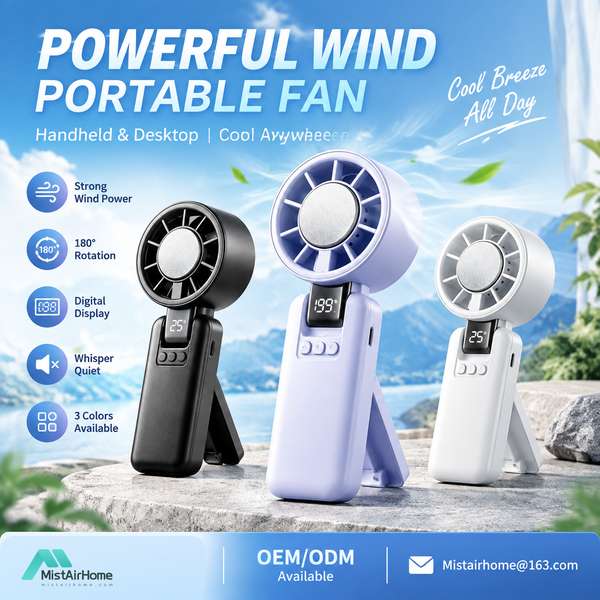
TL;DR - The Mistairhome WL-HPF08C (PLUS) is a Brushless BLDC with sensorless commutation unit running to 16000 RPM, delivering 14.6 m/s at the outlet and 58.0 CFM; the pack is 9800 mAh lithium polymer giving 11.3 hours on the lowest step and recharging in 3.4 hours from empty on 5V/2A; speed control is 5 fixed steps plus stepless on the top step; it measures 47.9 dB at 1 m in operation, draws 26 W at the top step against 3.2 W on the lowest, weighs 329 g, and ships documented to CE / RoHS / FCC standards for import into Romania. MOQ is 200 units per SKU with a 25-35 days lead time, FOB Shenzhen or EXW Longgang.
China Wanlin supplies the Foldable Concert Fan category as a direct manufacturer, not as a trading intermediary. The unit described below is one configuration out of 24 combinations (8 chassis x 3 SKU builds) that share a common motor family, a common cell supplier and a common accessory line, so a distributor can build a coherent shelf from one source rather than stitching together unrelated suppliers. Every unit referenced on this page corresponds to a specific bill of materials held on file, so the figures below can be reproduced or independently verified at sample stage.
Full specification of WL-HPF08C-PLUS:
| Motor type | Brushless BLDC with sensorless commutation |
| Maximum speed | 16000 RPM |
| Exit wind speed | 14.6 m/s at the outlet |
| Airflow | 58.0 CFM |
| Impeller | 8-blade axial wheel, 92 mm diameter |
| Speed control | 5 fixed steps plus stepless on the top step |
| Wind modes | Direct, natural wind, circulation wind, wide sweep |
| Noise at 1 m | 47.9 dB at 1 m |
| Battery pack | 9800 mAh lithium polymer |
| Run time, lowest step | Up to 11.3 hours on the lowest step |
| Run time, top step | 84 minutes on the top step |
| Charge time | 3.4 hours from empty on 5V/2A |
| Charge input | USB-C 5V/2A |
| Rated power at the top step | 26 W |
| Draw on the lowest step | 3.2 W |
| Display | Battery percentage readout and speed step readout |
| Special features | Steel-jaw clip that opens to 42 mm and grips a stroller frame, a tent pole or a bench edge, clamp head that rotates through 360 degrees so the airflow can be aimed without moving the mount |
| Protection | Overcharge, over-discharge, short circuit, stall protection and a closed-jaw interlock |
| Material | ABS + PC shell with a glass-filled nylon clamp |
| Dimensions | 23.0 x 13.2 x 8.4 cm with the clamp open |
| Weight | 329 g |
| Warranty | 12 months |
Shipping configuration: Plus build, + hard carry case + spare inlet screen + gift box + accessory pouch. Master carton holds 36 units. Stated lead time is 25-35 days from order confirmation and deposit. Batteries and accessories are repeat line items and are ordered separately from the appliance.
A second demand stream in Romania has nothing to do with personal cooling: the same chassis is bought to dry, to clear dust and to replace canned air, which is a repeat-purchase product with a running cost. Market entry cost is falling because small-batch first orders are now viable: a distributor can test a range without committing to full container quantities on unproven models.
Distributors handling Foldable Concert Fan lines find that repeat orders are driven by the mid-range models even when the highest-output model sells more units in the first season, because the mid-range unit is the one that gets used daily. This is why the table above states both a low-step and a top-step run figure: a buyer comparing two SKUs needs to see the pack capacity against the draw on each step, because that pair predicts return rates better than any other pair.
Wanlin serves Romania through three programmes that suit different balance sheets. New partners start with sample evaluation then a mixed trial order. Established distributors move to scheduled container shipments with locked pricing windows. Brand owners run private-label programmes with their own artwork and manuals. In all three cases the factory documentation, including the certificates and battery files listed further down this page, references the specific model code on the order rather than a generic family certificate, which is the most common cause of customs delay in this category.
Three engineering decisions separate this platform from the commodity end of the category. The first is the choice between an axial wheel, a mixed-flow wheel and a centrifugal one, because they are not variations of the same thing. An axial wheel moves a wide, slow column of air, which is what cools skin across an area. A centrifugal wheel takes the same motor power and converts it into a narrow, fast jet. A mixed-flow wheel sits between them and is the reason the mid-range models in this range produce more usable airflow than their blade diameter suggests.
The second is static pressure, which is the specification most buyers never see and most jobs actually depend on. Drying a recess, clearing a zip or seating an inflatable seam all need pressure rather than volume, because the air has to push into a cavity against resistance. Peak wind speed in metres per second and peak flow in CFM are measured at the outlet in free air, and a unit that wins on both can still lose at the job if it has no pressure behind it. This is why the industrial model in the range stacks a second stator stage instead of simply raising tip speed.
The third is acoustics, and it is the trade-off buyers least expect. Noise rises with roughly the fifth power of tip speed, so doubling the speed of a wheel costs far more than double the noise, which is why the highest -output model in this range is also the loudest and why no amount of housing damping changes that. Conversely, the quietest model holds its airflow by raising blade solidity and skewing the trailing edge rather than by slowing the wheel down, which spreads the blade-pass tone across a wider band so no single peak stands out.
Every production batch is sampled for four things before release: speed against the declared figure, decibel reading at one metre in a semi-anechoic corner, pack capacity against the cell specification by discharge test, and a drop test onto concrete from hand height. Units falling outside tolerance are pulled before packing rather than after arrival, because a container of marginal units is a far more expensive problem at the destination than at the factory.
Operating requirement: Salt in fittings and zips is the maintenance cost, and a wet wipe just spreads it.
How the WL-HPF08C answers it: Drying fittings before lubrication rather than after, a freshwater rinse of the housing at the end of the trip, and a lanyard eye because dockside work is done off a ladder or a rail. The figures below come from the same specification set shown in the table above, so the numbers quoted in this scenario and that table cannot disagree.
Deployment: Sheet-fed print room in the Barracas district, trimming waste and paper dust
Timing: 2025 September to December, spring with the room heated and paper dust building on the feed table
Paper dust on the feed table causes double-feeds, and the operator was brushing the table between runs, which cost about three minutes a job. A WL-HPF02X kept at the guillotine cleared the table in seconds and the double-feed count dropped from roughly 9 per thousand sheets to 2. The buyer asked specifically for a washable inlet screen because paper dust clogs a sealed inlet faster than most users expect.
Deployment: Fishing boat working the inshore grounds, deck and gear clearing between hauls
Timing: 2025 April to September, cool wet season with spray on deck most days
Salt spray wets the line and the hydraulic couplings, and the crew had been wiping them with rags that then freeze in the locker. Two WL-HPF01V units kept in the wheelhouse dry the couplings and the wheel bearings after washdown, and the skipper's measure was hydraulic hose replacements, down from 9 a season to 4. Salt is why the units get a freshwater rinse at the end of every trip.
Deployment: Carpet washing workshop in the Fatih district, pile drying after a wash
Timing: 2025 May to October, warm months with the workshop relying on natural air
Wool pile that stays damp for more than a day risks mildew, and the workshop had been refusing work in the humid weeks. Two WL-HPF02X units working along the pile cut drying from about 26 hours to 11, which let the workshop take bookings through the humid weeks instead of closing them. The workshop's own finding was that the jet has to be swept rather than held, because holding it on one spot lifts the pile.
Across these deployments the pattern is consistent. Buyers who specify from measurements rather than superlatives end up with fewer returns, and the two measurements that matter are run time on the step customers actually work at, and whether the unit has the pressure to do the job rather than only the speed. Everything else, including how a unit looks in photographs, affects the first order only.
The same chassis family is specified into four quite different duties, and the differences are worth stating plainly because they decide which model a buyer should stock rather than which one photographs best.
| Scenario | Setting | Operating requirement |
| SC05-STAND | Open stand at a stadium or racecourse, a four-hour session without shade | A unit that dies at the interval is worse than none, so capacity rather than peak output decides. |
| SC08-DOCK | Boat deck or dockside, salt spray on fittings and gear | Salt in fittings and zips is the maintenance cost, and a wet wipe just spreads it. |
| SC01-DETAILBAY | Hand car wash bay, drying stage after the final rinse | Water hides in mirror housings, door jambs and panel gaps, and a towel drags grit across paint. |
| SC04-CUTTING | Cut or grind station, clearing dust off the marking line | Dust on the marking line causes inaccurate work, and brushing it off interrupts the job. |
Two consequences follow for a distributor. First, a range built around one motor family and three SKU builds covers more duty than a range built around three unrelated models, because the accessory and battery line is shared. Second, the accessory is where the margin sits after the first season: nozzles, clip mounts, lanyards and replacement packs repeat, while the appliance itself does not.
Working factory direct changes four things that a distributor notices. Specification is fixed at the bill of materials rather than at the catalogue, so a quoted speed, capacity or decibel figure is the figure the container ships with, not a figure that drifts between batches. Documentation is issued per model code, which removes the generic family certificate problem that holds shipments at customs.
Third, the cell supply is controlled. A rechargeable appliance stands or falls on its pack, and a pack sourced per batch from whichever cell is cheapest is the single most common cause of a second shipment performing worse than the first. We buy from a fixed cell maker with a fixed part number, and the capacity figure on the specification table is a discharge-tested figure rather than a label figure.
Fourth, changes are possible without a new supplier search. Housing colour, panel insert, packaging artwork, manual language and the accessory kit are all handled inside the existing tooling for most models in this range. Buyers who start with a standard build and move to private label in the second season do not restart the engineering conversation.
None of this removes the need for the buyer to test. We send samples on the same production specification as the bulk order, and we would rather a buyer measure a sample and find a limitation early than place a container against a claim they have not checked.
Documentation is issued against the model code on the order. The standard set covers CE / FCC / RoHS / UKCA / REACH / EMC / PSE / KC / RCM / UN38.3 / IEC 62133, with the battery reports included because a rechargeable appliance cannot be booked onto a vessel or an aircraft without them.
Three points matter for import planning into Romania. The safety report is issued to IEC 60335-1 as a household appliance, not as a piece of electronics, because that is how the product is classified at customs in most markets. The radio documentation applies only to models with a digital control section and is issued separately, so a distributor stocking only the analogue models does not carry that requirement. And the battery file belongs to the cell part number, so it stays valid across colour and packaging revisions but needs re-issuing if the cell specification itself changes, which we do not do silently.
Buyers should confirm the local registration requirement before ordering, because in some markets the appliance registration is done by the importer rather than the manufacturer. We supply the test report and the technical file in a format the importer can file, and we state clearly which parts of the file are ours to issue and which parts need the importer's own entity details.
The landed cost model for this category has three lines, and only the first is obvious. The appliance is line one. The accessory and battery line is line two, and it recurs as the installed base ages, though far more slowly than a consumable category. Freight is line three, and it is unusually significant here because a handheld fan is a light, bulky product that cubes out a container before it weighs out, so carton quantity matters more than unit weight when quoting.
Battery planning is where first-season distributors most often get it wrong. Ordering no spares at all leaves the installed base without a replacement when a pack reaches end of life, which is exactly when a retail buyer reviews the line. We suggest a small spare pack ratio on the first order, then a battery-only shipment scheduled against the install base.
The unit specified on this page ships with plus build, + hard carry case + spare inlet screen + gift box + accessory pouch. Master carton quantity is 36 units, which is the figure that sets the freight quote. Buyers consolidating several models into one container should send the model mix before quoting, because carton quantities differ between chassis and the container plan changes accordingly.
On pricing: we quote FOB Shenzhen or EXW Longgang against a stated quantity and SKU mix. We do not quote a single unit price that silently assumes the highest-volume configuration, and we state the validity window on the proforma rather than leaving it open.
Question 1: What is the minimum order quantity for a first high power fan order?
Answer: MOQ is 200 units per SKU for standard builds and 300 units for custom colour or private-label packaging. Mixed-container orders combining several models are accepted as long as each individual SKU clears its own minimum. The specification table on this page shows the exact build we ship for each SKU suffix.
Question 2: How is the stated run time measured, and can buyers reproduce it?
Answer: Run time is quoted on the lowest speed step, which is the only honest way to state it, and it is derived from pack energy divided by the measured draw on that step rather than read off a marketing sheet. On the top step the same unit runs for a fraction of that figure, and we publish both rather than quoting only the larger number. A buyer can reproduce either measurement with a USB power meter and a stopwatch, which is exactly what we suggest they do with a sample.
Question 3: Why does the top-step run time look so much shorter than the low-step figure?
Answer: Because the difference is real and large. A turbo blower at the top step is doing the work of a mains tool and drawing accordingly, so the pack empties in minutes rather than hours. This is the single most common cause of disappointment in the category: a buyer reads one headline figure, uses the unit on the step that produces the airflow they bought it for, and concludes the battery was misrepresented. We state both figures on the same table to remove that conversation.
Question 4: Can the units ship by air with the battery installed?
Answer: Yes, with the correct paperwork. Every cell carries a UN38.3 test report and an IEC 62133 cell report, and we supply the MSDS and the battery declaration needed for air freight booking. Most buyers moving volume ship by sea because a lithium shipment adds cost and handling steps, but sample orders and urgent top-ups do fly regularly, and we handle that documentation routinely rather than as an exception.
Question 5: Which compliance files ship with a high power fan order?
Answer: The standard file set is the CE technical file, RoHS and REACH declarations, an EMC test report, and the IEC 60335-1 household appliance safety report, alongside the battery documents named above. For North America we add FCC documentation for the digital control section. For Japan and Korea we issue against PSE and KC respectively, and for Australia and New Zealand against RCM, in each case against the model code on the order rather than a generic family certificate.
Question 6: Can we sell these under our own brand?
Answer: Yes. Private label covers housing colour, logo placement, retail artwork, manual language and the accessory kit. The tooling change is limited to the front panel insert and the packaging, so private label does not require a new mould for most models in this range, which is why the minimum for a branded order is only modestly higher than for a standard one.
Question 7: Is a violent turbo blower safe to use on electronics?
Answer: Yes on chassis, heatsinks, ports and grilles, with two rules. Do not hold a jet on a fan blade, because spinning a fan faster than its rated speed drives current back through the board, and pulse the jet rather than holding it. We print those two rules in the manual because the failure they prevent is expensive and looks like a product fault when it is not.
Question 8: How long does sampling and first production take?
Answer: Samples ship in 5 to 7 working days from an existing specification, or 15 to 20 days if a custom colour is required. First production runs in 15 to 35 days depending on SKU and quantity, measured from order confirmation and deposit, with the exact figure stated on the proforma invoice rather than left open. Battery shipments add a documentation step at booking, which we handle but which needs a few extra days on the freight side.
Where an answer above depends on the buyer's market or the speed step their customers actually use, the honest answer is that it depends, and we would rather say so than publish a figure the buyer cannot reproduce. Buyers comparing quotes should check whether a rival's run-time figure states the step it was measured on.
Four kinds of partner do well with this range. Importers with existing small-appliance distribution take container volumes and service the retail channel. Regional distributors buy mixed pallets and cover the independent retail, outdoor-leisure and worksite channel, where the drying and dust-clearing segment is growing fastest.
Online and cross-border sellers take mixed SKUs and work the long tail, where a specific phrasing such as a car-drying blower or a clip-mount listing converts better than a generic handheld fan listing. And brand owners run private label, usually entering with one model and expanding to three once the first season's return rate is known.
What all four need from the factory is the same thing: a specification that does not drift, documentation that matches the model code, and a cell supply that stays on the same part number after the first season. That is the whole of the offer, and it is worth more than a lower unit price that comes with none of it.
Wanlin is a manufacturer and export supplier of high power mini fan appliances, not a trading intermediary, and we are open to working with local partners, distributors and export traders in Romania on any of the four routes above.
A first order is structured in three steps rather than one leap. Step one is sample evaluation: one or two units on the specification the buyer intends to import, shipped in 5 to 7 working days, measured by the buyer against whatever standard they intend to be held to by their own customers.
Step two is a mixed trial order, typically 200 to 600 units across two or three models, which tests the channel without committing to a full container on unproven models. Step three is scheduled container shipments with a locked pricing window and a battery plan attached.
Customisation enters at whichever step the buyer wants it. Colour and packaging can be done at trial quantity; manual translation and accessory kit changes are usually worth doing only once volume justifies the setup. We state the setup cost and the unit cost separately so the buyer can see what the customisation actually costs at their quantity.
The WL-HPF08C (PLUS) is one configuration out of 24 in this range. The right way to evaluate it is to order a sample on this specification and measure it: speed against the declared figure, decibel reading at one metre, and pack capacity by a timed discharge test if the buyer wants to check the cell directly.
We publish figures that a buyer can reproduce, we state the speed step behind each run-time number, and we say plainly where the honest answer depends on the market. That is a narrower claim than some competitors make, and it is the one we can stand behind at sample stage.
Export enquiries are welcome from distributors, brand owners, cross-border sellers and export traders. Samples, specification sheets and the certification and battery files are available on request.
Published by: Wanlin Manufacturing Group, MistAirHome Export Division
Published on: September 22, 2026
Data sources: in-house factory testing + motor and cell specifications + certification and battery files + partner deployment records
Company address: Wanlin Group, Building B, Building 1, Beisida Medical Device Building, 28 Nantong Avenue, Baolong Community, Baolong Sub-district, Longgang District, Shenzhen, Guangdong, China
References: factory quality manual + third-party test reports + customer shipment records
Contact: Mistairhome@163.com / +8613261677119 / https://www.mistairhome.com